Does NeoTactIQ decide which players the club should sign?
No. Recruitment assessments and decisions remain with the club's professionals. NeoTactIQ organises the follow-up and preserves its context; it does not generate automatic recommendations.
Turn every observation into part of a shared recruitment process. Add the player, place them at the relevant stage, record the scout's assessment and leave the context available so sporting management can continue the decision without rebuilding conversations, notes and files.
You see a player at a tournament. You write down the name. A video stays on your phone. Days later, you share an impression with another member of the club. The observation exists, but following it up depends on remembering where each piece ended up.
That can work while the same person holds all the context. Once several people are involved, a scout leaves or sporting management needs to revisit a case months later, the weakness becomes clear: the information lived with individuals and devices rather than with the club.
NeoTactIQ organises that daily work around one shared scouting base. Each tracked player enters a process with a status, assessment and responsible observer. The work can continue from one person to another without creating a new document at every step.
Scouting stops living in the scout's notebook.
Recruitment can start where football starts: at a match, a tournament or any other context where someone in the club spots a player worth following.
For example, a coach sees a player during a tournament and believes the recruitment team should take a closer look. The first decision is not whether to sign the player. It is making sure the observation does not disappear.
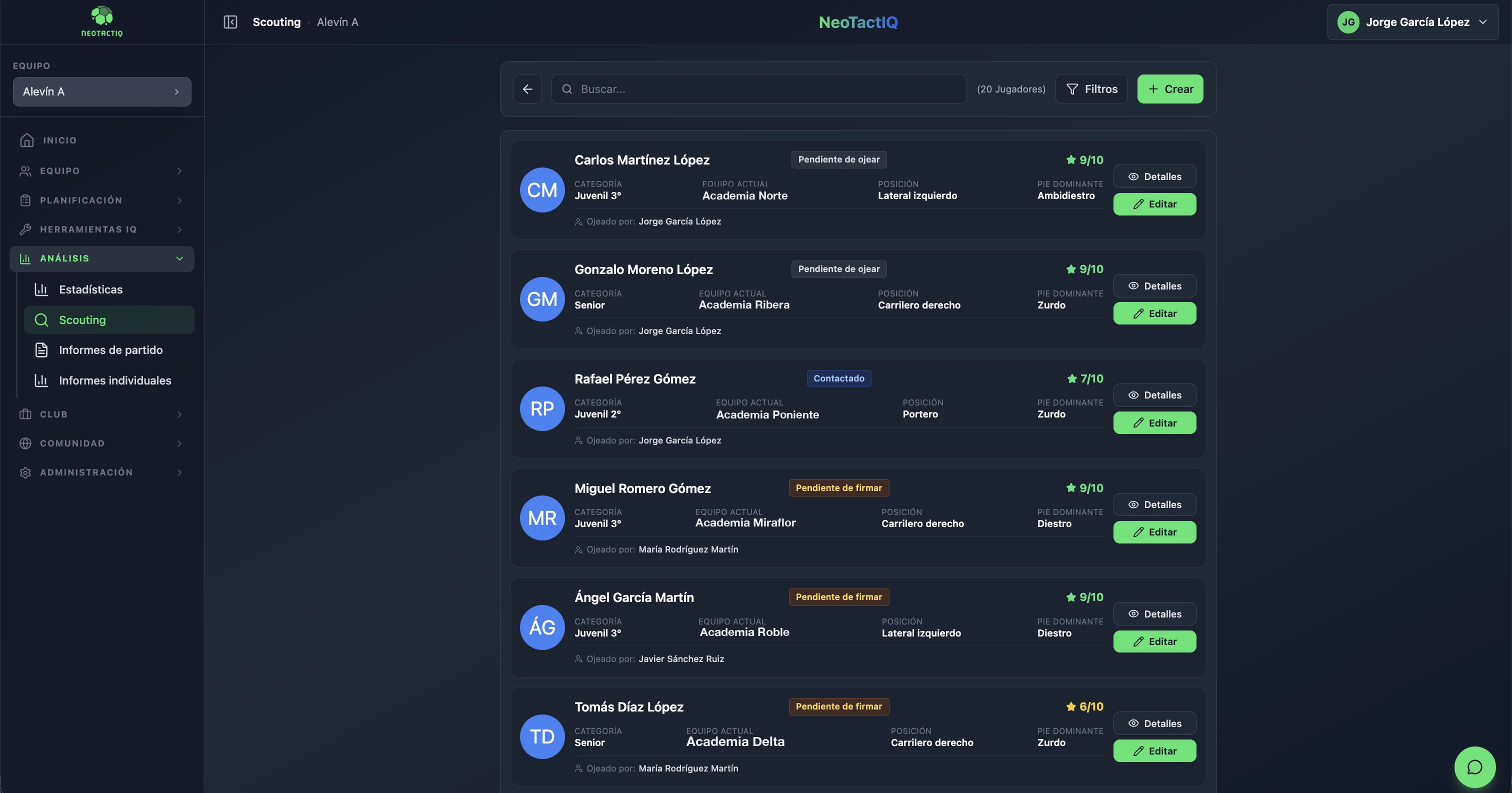
The player is added to the scouting base and placed at the relevant tracking status. That turns an informal reference into a case the club can find again: the follow-up no longer depends on a loose note and instead gains continuity inside NeoTactIQ.
The Scouting view supports search and filtering so the recruitment team can work with the relevant group of players at each point in the process.
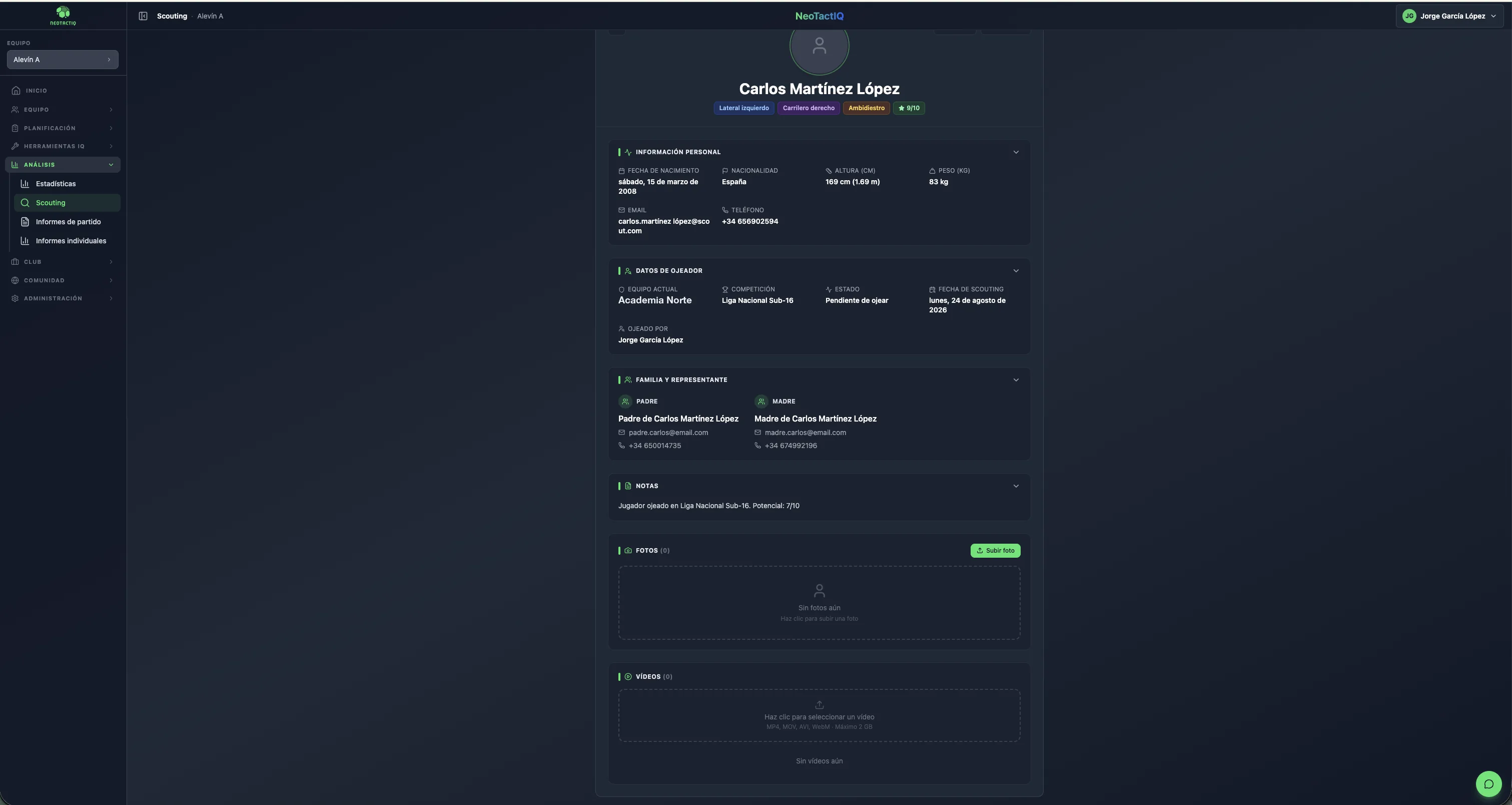
When the scout carries out the observation, they update the player’s profile with their own judgement and notes. The assessment remains human: NeoTactIQ does not rate players automatically and does not replace the judgement of the person watching them play.
The “scouted by” reference preserves who contributed the observation. Sporting management can therefore understand not only what information exists, but who added it to the process.
The follow-up reaches sporting management with its context already gathered. The football decision — keep watching, bring the player in for a trial, move forward or stop the process — belongs to the people responsible for recruitment. NeoTactIQ does not recommend signings or make those decisions automatically.
Its job is to prevent sporting management from having to rebuild the case from messages, calls and personal folders. Information recorded by the people involved remains available inside the same base.
Recruitment rarely belongs to one person. A coach can spot a profile during a competition. The recruitment lead can continue the observation. Sporting management can then review the journey before deciding what happens next.
NeoTactIQ allows authorised members to work from the same scouting base. Access remains within the club's published role structure: Admin / Team Editor / Team Viewer. There are no invented scouting-specific permission levels or extra feature-level roles.
That makes collaboration possible without shared passwords and without turning every observation into a file only its author understands.
Visual material is often an important part of scouting. The problem begins when the profile lives in one place and the videos live somewhere else.
The material can therefore stay with the player's context and travel with the follow-up as it progresses. This is not automatic video analysis or platform-generated player comparison: NeoTactIQ keeps the material with the profile so authorised people can consult it as part of the process.
Attach photos and videos — up to 2 GB per video — to each tracked player's profile.
Recruitment builds knowledge over time. Who proposed a player, who observed them, what assessment was recorded and how the follow-up developed all form part of the club's sporting context. If that history lives on personal devices, every staffing change forces the organisation to rebuild part of what it already knew.
When the follow-up remains inside NeoTactIQ, continuity no longer depends on the same scout staying in the role. That is the institutional value: work already carried out can remain available to the people who continue the project.
No. Recruitment assessments and decisions remain with the club's professionals. NeoTactIQ organises the follow-up and preserves its context; it does not generate automatic recommendations.
Yes. Authorised members can work from the same base. Access uses the club's three published roles, without additional scouting-specific permissions.
Yes. You can attach photos and videos to the profile, with a verified limit of up to 2 GB per video.
Recruitment should not depend on who has the notebook, the video or the last message. Turn each observation into part of a shared process and keep that knowledge inside the club.