
The v3_FINAL version
One coach updates the file, someone else keeps an older copy, and nobody is completely sure which version contains the current information.
Spreadsheets are flexible, familiar and useful for many jobs. The problem begins when a spreadsheet becomes the operating system for a team or an entire club. NeoTactIQ connects rosters, planning, matches, statistics and seasons so information can continue from one football workflow into the next.
No credit card · Free tactical board forever
The problem is not the spreadsheet. It is asking one to model relationships it was never designed to understand.
At first, a workbook with several tabs may be enough. Then familiar situations start to appear.
One coach updates the file, someone else keeps an older copy, and nobody is completely sure which version contains the current information.
A row is inserted, a reference changes or a cell is copied, and a table that used to work no longer adds up.
Part of the team's structure depends on one person's way of naming and organising folders.
The same players are entered again because each file solves a separate part of the workflow.
When the next year starts, the old context still exists somewhere, but someone has to remember where it lives and how it was organised.
None of this makes spreadsheets a bad tool. It shows something else: a blank sheet does not inherently know what a roster, microcycle, squad selection, match or season is.
NeoTactIQ is not trying to win a checklist comparison. The difference is what happens to information after you enter it.
Rosters, sessions, matches and seasons stop living in separate files.
In a spreadsheet, you can maintain a complete player table, but when matchday arrives you need to reuse that information in another document. In NeoTactIQ, the roster belongs to the team: from that context you prepare the match squad using players who are already registered. The player is not a row you need to copy again; the player belongs to a workflow.
A spreadsheet can show what you plan to work on Thursday, but its relationship with the wider season depends entirely on the structure you built yourself. In NeoTactIQ, each training event keeps its date, logistics, zone, phase, objective and load, and is automatically assigned to its microcycle according to its date inside the cycle structure.
A spreadsheet can record the result and let you build your own formulas afterwards. In NeoTactIQ, you record goals, cards, assists and substitutions during the game; the platform automatically keeps an exact-minute timeline, and match statistics are calculated automatically from the recorded activity.
The work you already have does not need to be treated as something to throw away.
Your current file can be the starting point for bringing players into NeoTactIQ without re-entering the roster from scratch. Import works as a bridge between the way you have worked until now and a structure where the same information can continue into later workflows.
From that point on, the roster is no longer an independent table. It becomes part of the team's context and can connect with what comes next.
Import your complete roster from Excel when you start.
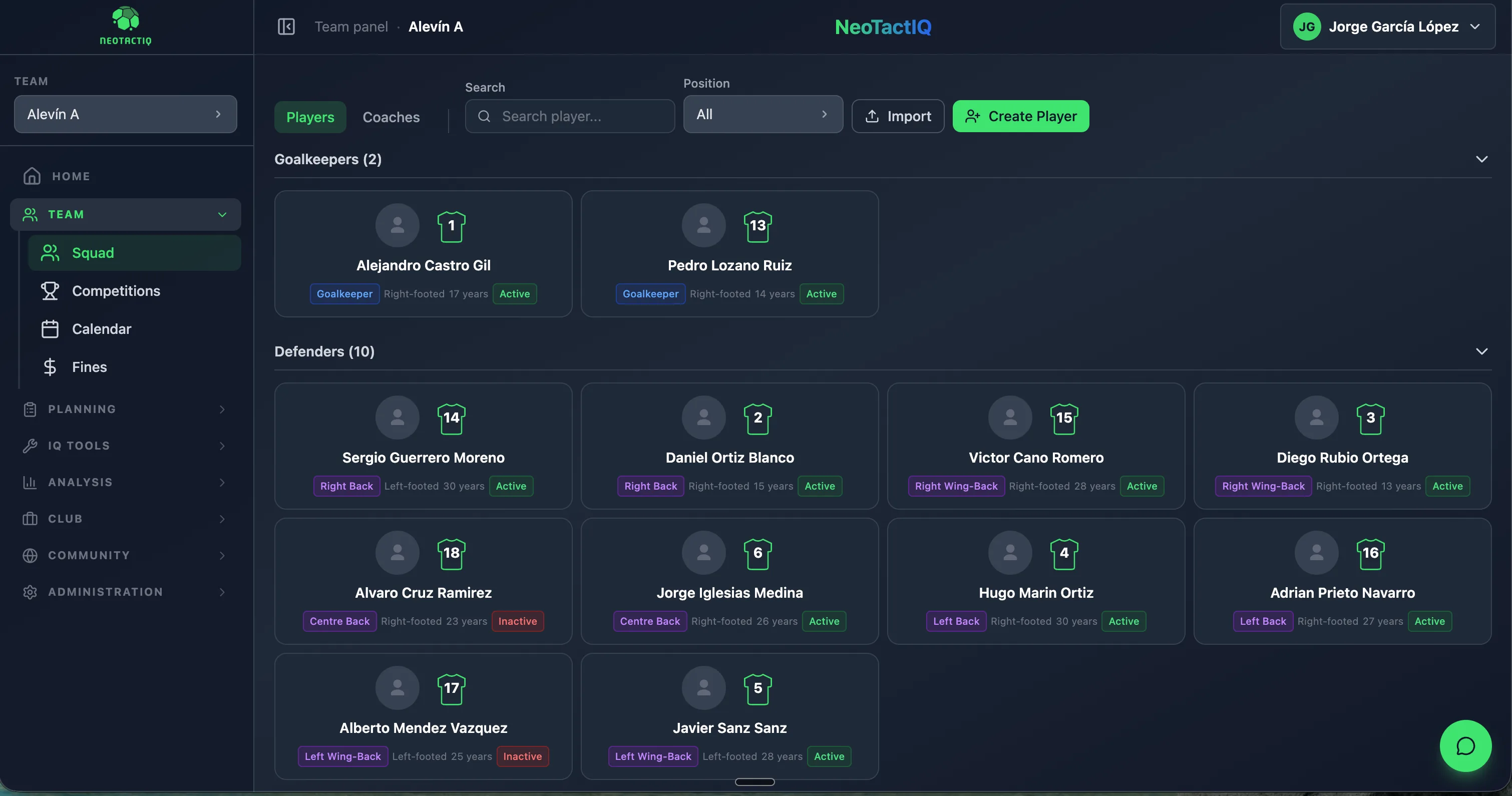
A specialist platform does not give you the absolute freedom of an empty spreadsheet.
In Excel, you can invent any column, write any formula and build a completely personal structure. If you need a one-off table with no connection to the rest of your football operation, a spreadsheet may still be the right tool.
NeoTactIQ starts from a different idea: represent real football workflows inside a shared structure. That means working with defined concepts such as teams, players, cycles, training, matches, statistics and seasons.
You give up some of the freedom to design every file from zero. In return, you do not have to manually build the relationships between those files. The choice is not “Excel for everything” or “never open Excel again”: you can keep using spreadsheets where they make sense and use NeoTactIQ for the work that needs football continuity.
When information is connected, one action can feed the next.
The roster supports squad selection. Training stays inside its cycles. What you record during a match feeds the timeline and match statistics. When a season closes, the club can preserve it as history.
That is the meaningful change compared with a collection of files: knowledge depends less on how one person named a folder or built a formula.
For a coach, that means less reorganisation between tools. For a club, it means the structure can remain when people change.
Close the season and keep the history: the club does not start from zero every year.
Not necessarily. Excel remains useful for one-off calculations and tables. NeoTactIQ is designed for football workflows that need continuity between rosters, planning, matches, statistics and seasons.
Yes. Import your complete roster from Excel when you start. You do not need to re-enter every player manually before beginning.
A spreadsheet may not add a specific new cost if you already use the software. The difference is the work required to maintain versions, relationships and calculations when the club depends on several separate files. NeoTactIQ starts from a connected football structure. You can also start with the tactical board, which is free forever with no credit card.
NeoTactIQ lets the club keep work inside its structure and preserve closed seasons as history. Knowledge does not need to depend only on the personal files of whoever happened to be there at the time.
Yes. Adopting NeoTactIQ does not mean giving up spreadsheets for one-off needs. The proposal is to stop depending on a blank sheet to connect the club's entire sporting operation.
You do not need to rebuild the club to change systems. Start by importing what you already have, then let that information continue through the workflows you actually use: roster, planning, match, statistics and seasons.
No credit card · Free tactical board forever