Skip to content
Soccer game model

Your game model, written down and working

Turn your playing identity into a structure you can use throughout the season. Define behaviours by phase and zone, connect that idea with the weekly work and then check how the training you actually record is distributed.

No credit card · Free tactical board forever

A game model is not a formation

A 4-3-3 tells you how the players are initially positioned. Your game model explains how you want the team to behave in possession, out of possession and when possession changes.

That is the difference between a shape and a playing identity.

NeoTactIQ lets you write that identity down inside a shared structure. Define behaviours by phase and zone in your game model. The model no longer depends only on what the coach remembers or explains verbally.

While the idea exists only in your head, the club does not own it. Once structured, it can become a stable reference for the work of the season.

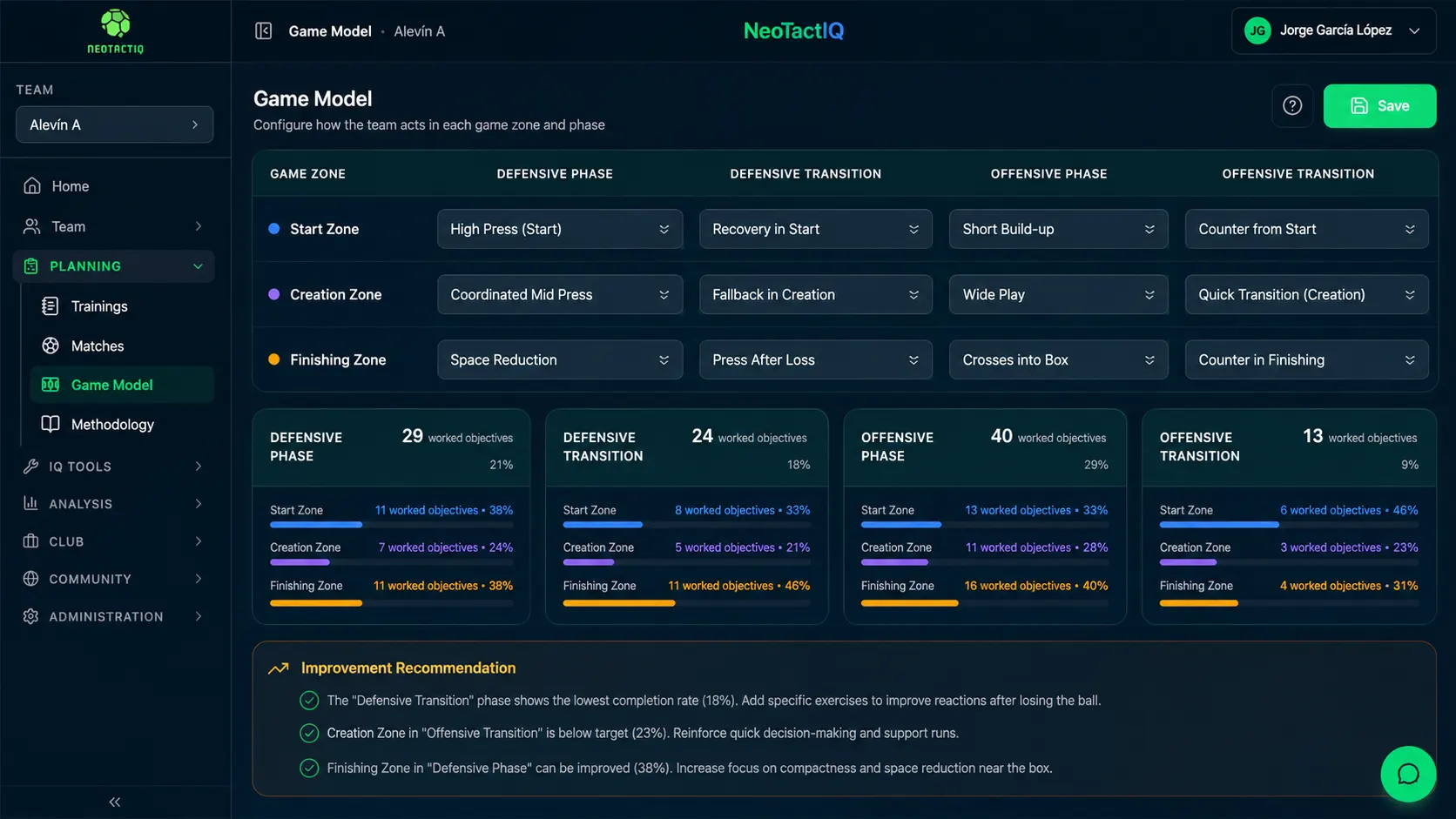
A 4-phase × 3-zone matrix

NeoTactIQ organises the game model by crossing four moments of the game with three zones of the pitch.

The four phases are attacking phase, defensive phase, attacking transition and defensive transition. The three zones are build-up, creation and finishing.

Together they create twelve working spaces where football behaviours can be defined. For example, you can describe how you want to start progressing with the ball, what behaviour you expect in the creation zone, how the team should react after losing possession or what defensive intention you want close to the opposition goal.

The purpose is not to produce a theoretical document. It is to organise behaviours that can later be recognised in your planning.

Game model by phases and zones in NeoTactIQ
Your playing identity organised by four phases and three pitch zones.

Cross how you want to play with what you actually train

The game model becomes more useful when it stops being a separate document.

Within the same framework, you can relate the identity you defined to the work recorded during the season. NeoTactIQ shows how work is distributed across phases and zones and detects imbalances.

That lets you check whether the ideas you describe as part of your game model are actually appearing in training. If one phase or zone receives less work than expected, you have evidence to review the next planning block.

The platform does not decide what your ideal distribution should be. The coach still defines the model and makes the methodological decisions.

A recommendation to review the balance of the work

NeoTactIQ uses that distribution to help you notice when the recorded work is losing balance across phases and zones.

The recommendation does not replace your judgement. It points to where it is worth looking before you build the next microcycles.

Shows how work is distributed across phases and zones and detects imbalances.

From paper to the pitch: connect the model with methodology

Writing the game model down is the first step. The next is using it as a reference for structuring the season.

With cycle-based methodology, you can organise macrocycles, mesocycles and microcycles and define the priorities of each period. Each training event then keeps its phase, zone and objective inside that context.

The workflow stays connected: define how you want to play, decide what you want to work on in each period, then return to the recorded data and check what you actually trained.

Frequently asked questions

What is a game model in soccer?

It is the definition of the behaviours you want from your team in different moments and areas of the game. It is not simply a starting formation; it is a reference for how you want to attack, defend and react when possession changes.

How does NeoTactIQ structure the game model?

It uses a matrix with four phases — attacking, defending, attacking transition and defensive transition — and three zones — build-up, creation and finishing.

Does NeoTactIQ create the game model for me?

No. The coach defines the team's behaviours. NeoTactIQ provides the structure for writing them down and relating them to the work recorded during the season.

Can I check whether I am actually training my game model?

Yes. NeoTactIQ shows how work is distributed across phases and zones and detects imbalances. That lets you compare the defined model with the work recorded in training.

How does the game model connect with methodology?

The game model defines how you want to play. Methodology organises when and with which priorities you work during the season. Training then provides the record needed to compare intention with execution.

Write down how you want to play. Then check what you train.

Your game model does not have to remain a PDF nobody opens again. Turn it into an operational reference and use it to give context to methodology and weekly work.

No credit card · Free tactical board forever