
Skip to content
Football session planner

The football session planner

Plan Friday's training without separating it from the rest of the season. Keep logistics, phase, zone, objective and load in one training record, place each training day inside its microcycle and return to the recorded work later to check what you actually trained.

No credit card · Free tactical board forever

One training record for what you are going to work on — and why

Every training day has a practical side you need to solve before stepping onto the pitch: when you train, how much time you have and where the work will take place. But it also needs to answer football questions. Which phase are you working on? In which zone? With what objective? What load are you targeting that day?

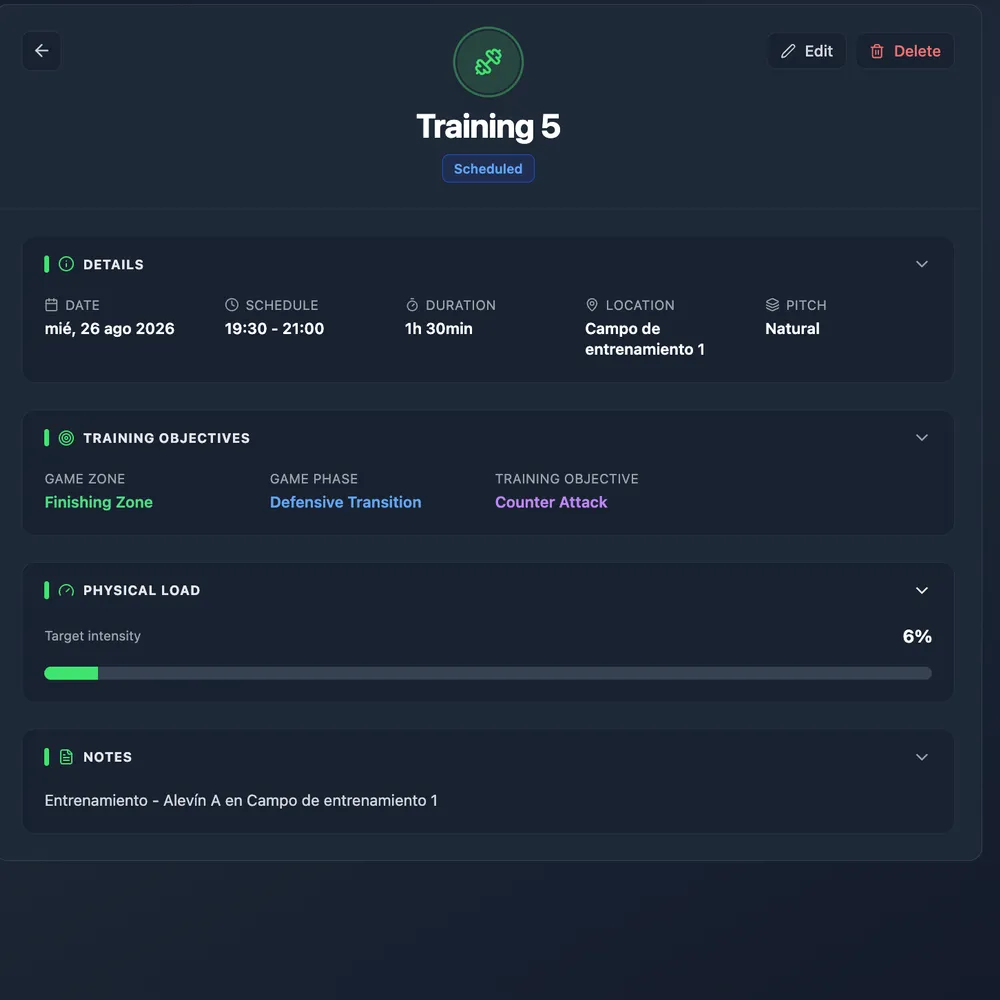
NeoTactIQ keeps those decisions together in the training record. You can register logistical information — date, time, duration and location — alongside the sporting context: pitch zone, game phase, tactical objective and target intensity.

That makes each training day part of the week rather than an isolated row in a spreadsheet. The purpose is not to make planning more complicated. It is to make your intention clear before training and preserve that context for when you need to review it later.

Every session brings logistics, cycle, zone, phase, objective and load together in one record.

Training record in NeoTactIQ
Date, duration, zone, phase, objective and load brought together in the training record.

Training does not live on its own: microcycle, mesocycle and macrocycle

Friday does not begin on Friday. It belongs to a week, that week belongs to a larger block, and that block has a place inside the season.

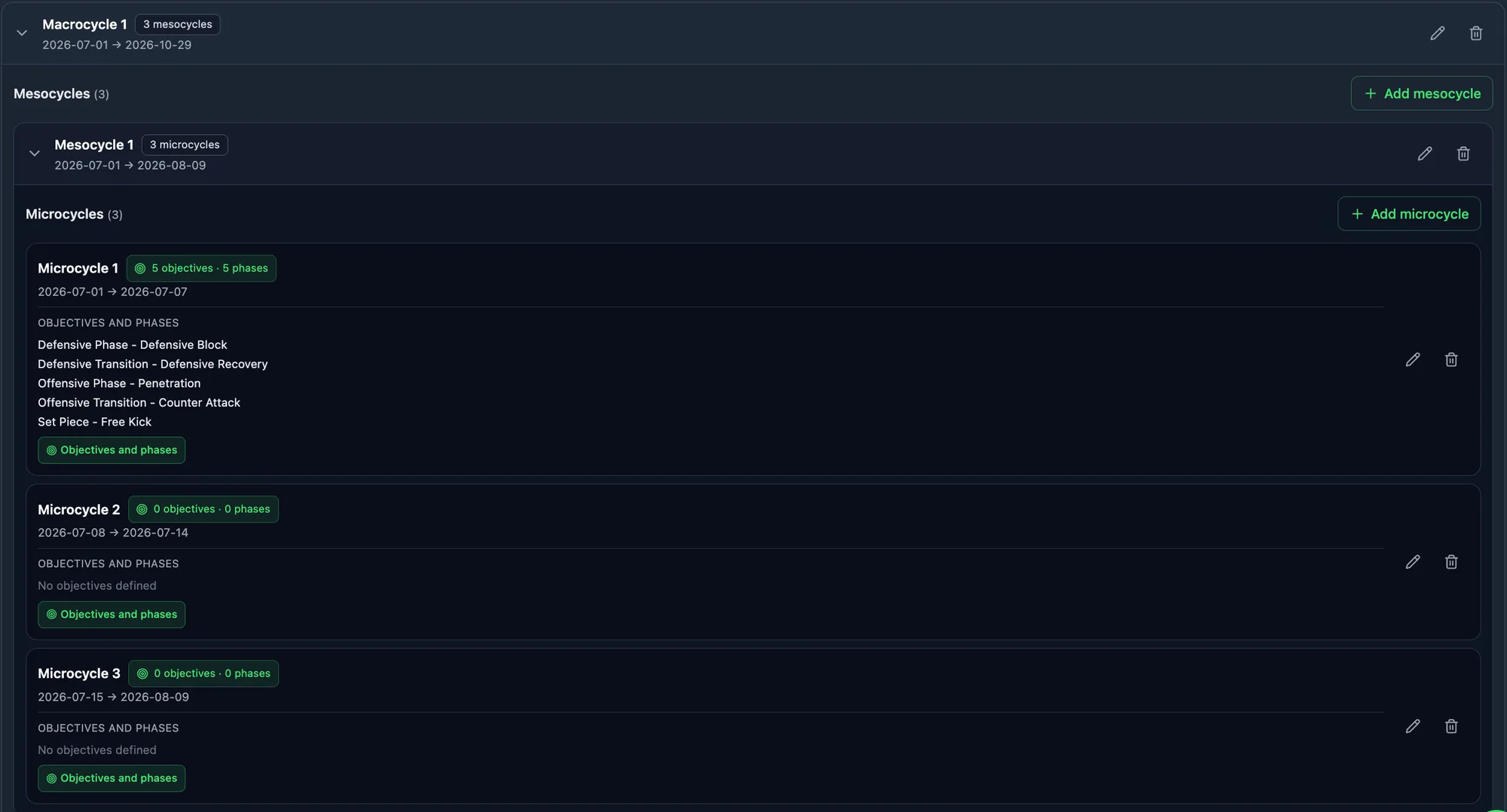
NeoTactIQ lets you structure the work through microcycles, mesocycles and macrocycles. You can plan a specific week without losing sight of what came before or what you want to develop next.

When you need a wider view, the microcycle sits inside its mesocycle and macrocycle. You can therefore move from “what are we doing on Friday?” to a more useful medium-term question: “what are we building during this period?”

Each training event is automatically assigned to its microcycle according to its date.

Methodology cycles in NeoTactIQ
The training day sits inside its microcycle and the wider structure of the season.

Microcycle objectives: give the week a clear intention

A training week should be more than a sequence of occupied days. The microcycle gives the work a common intention and lets you connect individual training days with the priorities of the period.

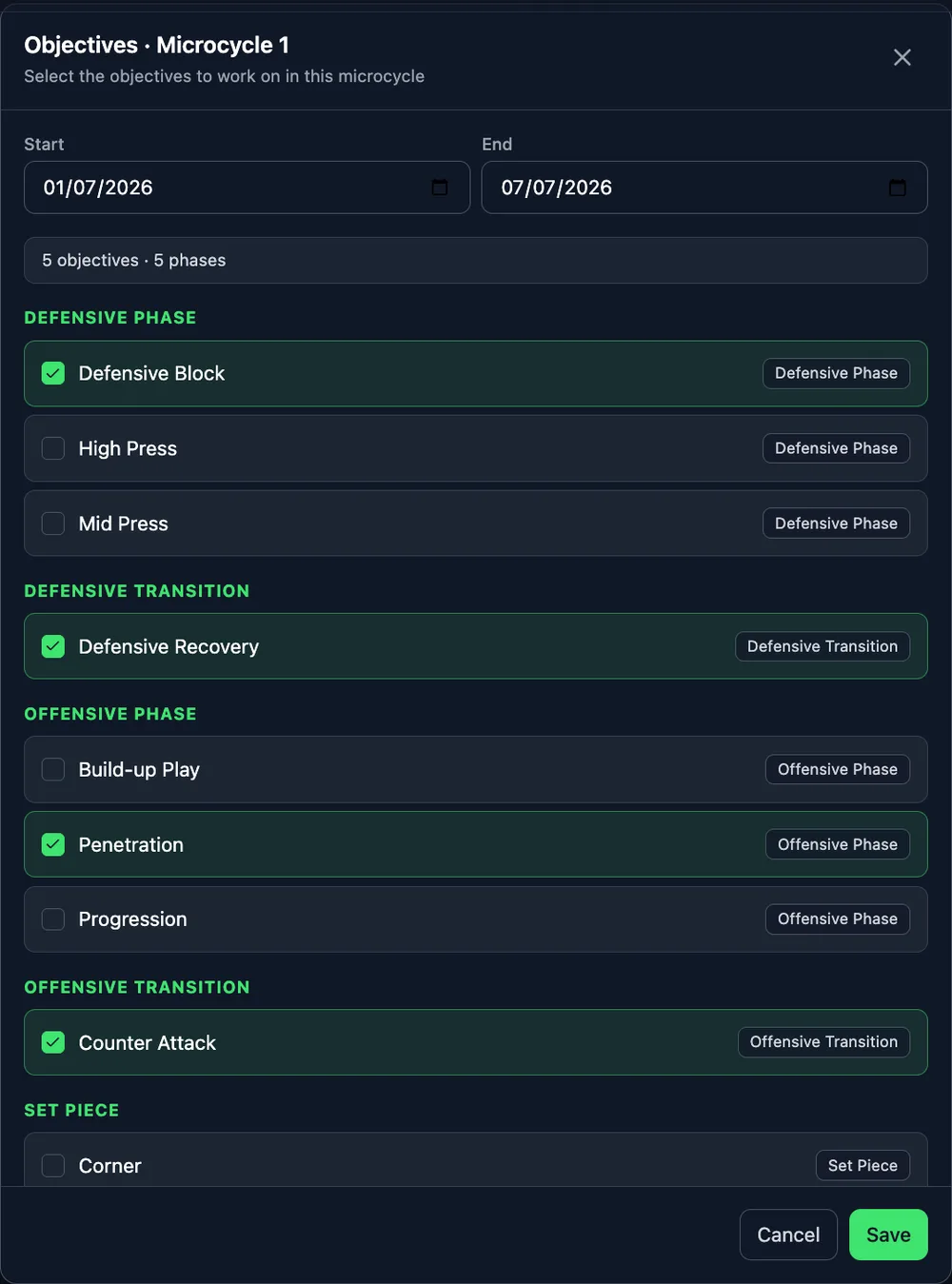
You can define objectives for the microcycle and use that framework to decide what needs attention during the week. Work families can include attacking, defending, transitions and set-piece work, treated here as training content within the plan.

Each training day then makes that intention specific through its own phase, zone and objective. The microcycle provides the context; the training record translates it into a particular day.

This also helps when the calendar forces a change. If you have fewer training days in a week or need to shift a priority after a match, you can still see what you intended to work on and how the revised distribution fits the cycle.

NeoTactIQ does not decide the content for you. You define the priorities and the work. The platform keeps the structure so you can return to it later.

Microcycle objectives in NeoTactIQ
Microcycle objectives organised by work family.

Check what you actually trained

A good plan in September has limited value if, by February, you cannot check what happened to it.

NeoTactIQ connects the context recorded in training with an accumulated view of the work. That lets you compare intention with execution without turning planning into administrative work. If you wanted the training load to be distributed in a certain way, you can return to the recorded data and see what has actually occupied your weeks.

The question changes from “what do I think we have been training recently?” to “how has the recorded work actually been distributed?”

There is no need to interpret thresholds or configure algorithms. The view is there to reveal imbalances so you, as the coach, can decide whether the next microcycles need adjusting.

That is the difference between storing a plan and working with live planning: you can review what happened and use it to prepare what comes next.

Shows how work is distributed across phases and zones and detects imbalances.

Use drills from your library instead of rebuilding the work

Planning the week also means deciding how you will take each objective onto the pitch. If you already have drills in NeoTactIQ, you can reuse that material rather than starting from a blank slide every time.

The drill library keeps your designs together with context such as phase, objective and difficulty. When you return to an idea you have used before, you can understand why it was created and adapt it to the current training day.

This separates two jobs that are often mixed together: planning what you want to train and designing the tactical content you will use to train it. Both can live inside NeoTactIQ without leaving your best exercises scattered across folders.

Frequently asked questions

Can I use NeoTactIQ if I currently plan training on paper or in Excel?

Yes. You do not need to change the way you decide what to work on. NeoTactIQ gives that planning a structure where each training day keeps its context and can be reviewed later inside the microcycle and the wider season.

Does NeoTactIQ create training sessions for me?

No. The coach decides the objectives, phase, zone, load and content of the work. NeoTactIQ organises that information inside connected planning and lets you review how the recorded work has been distributed afterwards.

How is a training day connected to the microcycle?

Each training event is automatically assigned to its microcycle according to its date. The microcycle, in turn, belongs to the season's mesocycle and macrocycle structure.

Can I check whether I am working some phases or zones more than others?

Yes. NeoTactIQ shows how work is distributed across phases and zones and detects imbalances. The decision on how to adjust future planning remains with the coach.

Can I reuse drills I have already designed?

Yes. Drills stored in your library can be reused and adapted when preparing future training. The library preserves the context of each drill so the work does not disappear into separate files.

Plan Friday with the rest of the season in mind

You keep making the football decisions. The difference is that each training day can now stay connected to the microcycle, its objectives and the accumulated work of the season.

Start by organising next week. Then come back to it and check what you actually trained.

No credit card · Free tactical board forever