
How to Evaluate Soccer Players: A Practical Guide
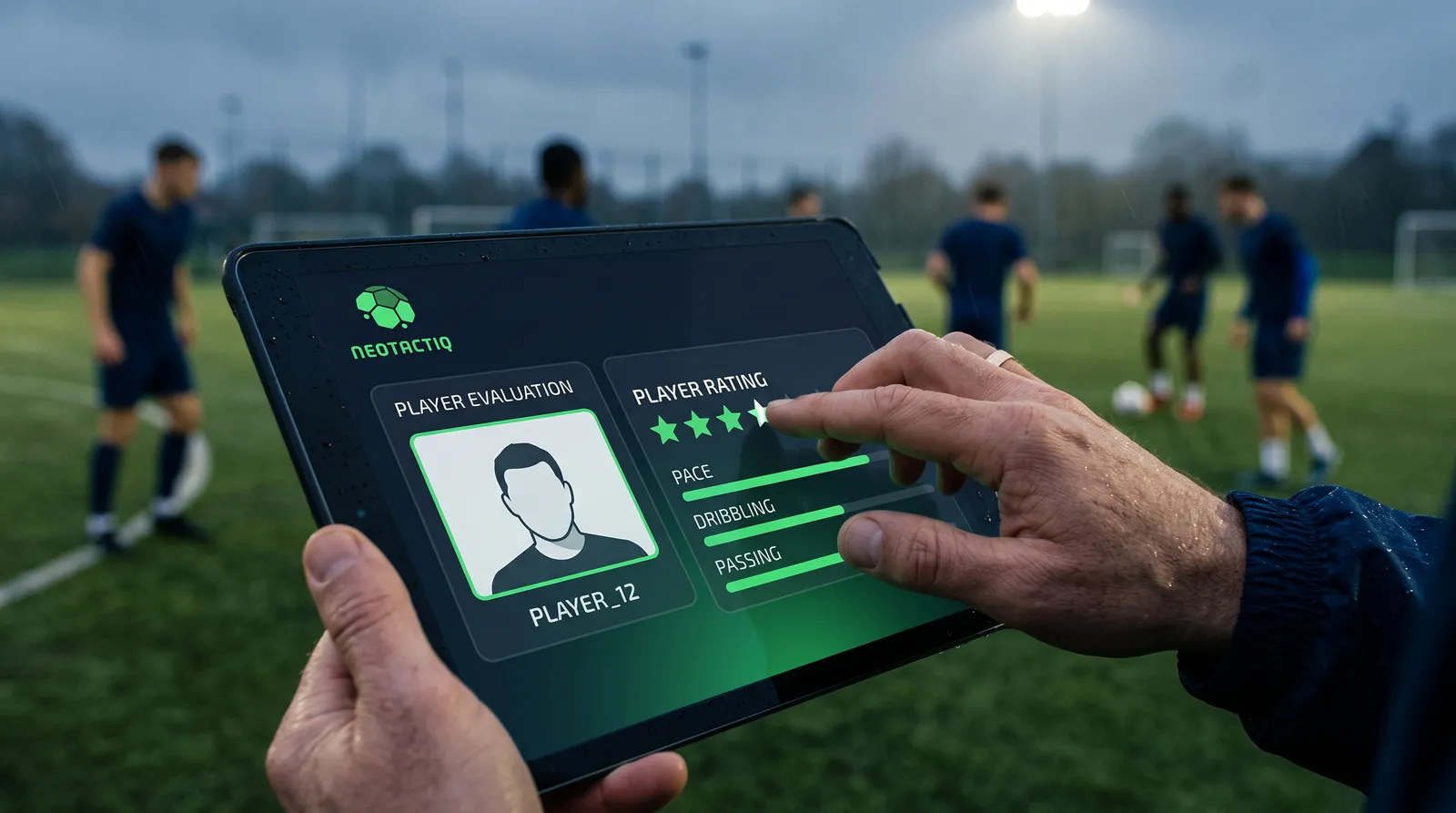
Evaluating a player is one of the tasks most coaches get wrong — not for lack of football knowledge, but for lack of structure. Without a clear framework, an evaluation becomes a general impression dressed up as a numeric score.
What to look for: technical, tactical, physical, mental
A complete evaluation covers four areas: technical (control, passing, dribbling, finishing), tactical (positioning, decision-making, understanding of collective play), physical (speed, endurance, strength relative to age) and attitudinal (commitment, response to mistakes, relationship with the group). Evaluating only one of the four gives an incomplete, often unfair picture of the player.
How to structure a tryout or evaluation session
A good evaluation combines regular training situations — where you see the player's real behaviour — with at least one small-sided game, which is where decision-making and positioning are best observed. Evaluating with drills alone overvalues pure technique and penalises players with great game reading but less flashy technical skills.
Common mistakes when evaluating players
The most frequent mistakes are: evaluating on a single day instead of across several sessions, being swayed by the result of the last match, confusing "the most physically dominant player" with "the best player" at youth levels, and failing to document the evaluation in writing, which makes it impossible to compare later.
From evaluation to an individual report
An evaluation that stays in the coach's head has no institutional value. Turning it into an individual report — even a brief one — lets you compare it with the next evaluation, share it with the family and the club, and back category-promotion decisions with more than an opinion.
Downloadable evaluation template
A minimum viable template includes: date, context of the observation, a one-to-five score for each of the four areas, and a free-text field for nuances the score doesn't capture. The important thing isn't the perfect template — it's using it consistently, session after session. With NeoTactIQ, that evaluation is saved directly into the player's development history, instead of staying on a loose sheet of paper.

Written by
Mario Fernández Osorio
Level III coach with 7+ years in Madrid grassroots football. Former analyst at Getafe C.F. and specialist in sports technology.
View full profile →